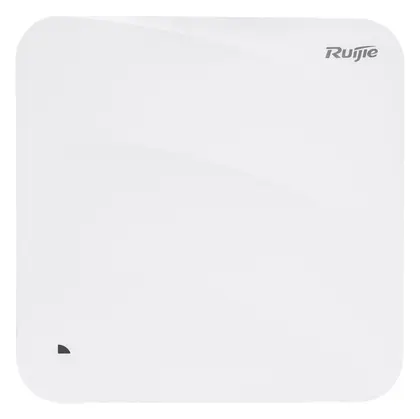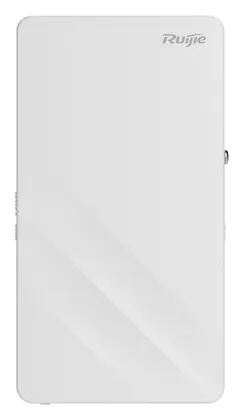
RUIJIE · RG-AP180-I

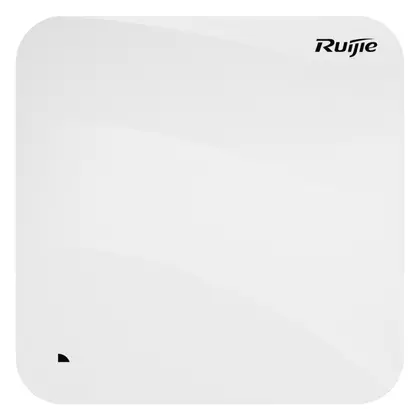
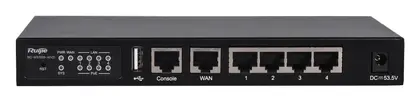
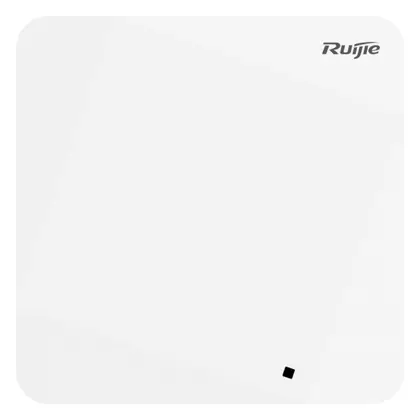
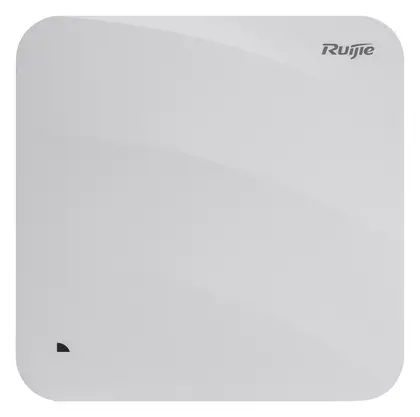
Ruijie RG-AP180-I Wi-Fi 6 Çift Bant Duvar Tipi Access Point
Model
RG-AP180-IRuijie RG-AP180-I access point: 4 x 1 Gbps downlink Ethernet ports, wired and wireless integration for cost-efficient networking, 2.976 Gbps ultra-fast speed with Wi-Fi 6, PoE and DC power supply, flexible deployment, Unified WIS cloud management, intelligent O&M.
- Kablosuz standart
- Wi-Fi 6
- 4 x 1 Gbps downlink Ethernet ports, wired and wireless integration for cost-efficient networking
- 2.976 Gbps ultra-fast speed with Wi-Fi 6
- PoE and DC power supply, flexible deployment
- Unified WIS cloud management, intelligent O&M
Genel bakış
Ruijie RG-AP180-I özellikleri ve kullanım alanları.
Indoor scenarios covering higher education, government, general education, finance, and commerce sectors
Wi-Fi 6 Enterprise-Grade High-Performance Wall Plate AP RG-AP180-I
4 spatial streams
Maximum Data Rate 2.976 Gbps
PoE Out/DC power supply
Bluetooth 5.1
Junction box/wall-mounted
Wired and Wireless Integration, Cost-Efficient Networking
1 x 2.5 Gbps uplink port + 4 x 1 Gbps downlink ports provide high-speed wireless connectivity while fully supporting wired network scalability * Dual-network integration, requiring fewer switches to slash networking costs
*LAN1 supports standard PoE output voltage (48V/10W).
2.976 Gbps Ultra-Fast Speed with Wi-Fi 6
High speed:
1024QAM modulation, 25% higher data transfer rate than 802.11ac
High concurrency:
OFDMA and MU-MIMO transfer technologies, 4x more concurrent users than Wi-Fi 5
High security:
Next-gen wireless encryption protocol WPA3 significantly enhances wireless security
Low latency:
OFDMA technology reduces the delay to as low as 20 ms, making it easier to watch videos and download documents
PoE Power Supply, Flexible Deployment
With PoE in, each AP only requires a single network cable to transmit both data and power. Easy deployment without external power supply.
Unified Cloud Management for Easy O&M
WIS Cloud Network enables network-wide configuration and optimization. It also supports O&M on the mobile app Wi-Fi Moho.
Cloud O&M
24 h Network Optimization
Real-Time Warning
Fault Locating
Go to WIS Cloud Network
Nerelerde kullanılır?
Ofis, otel, okul ve mağazalarda kesintisiz kablosuz kapsama ve dolaşım (roaming) için tavan veya duvar montajıyla kullanılır.
Teknik özellikler
Değerler üretici veri sayfasından derlenmiştir; proje öncesi güncel datasheet ile teyit edilmesi önerilir.
| 802.11n | Four spatial streams; Radio 1 – 2.4 GHz: 2x2 MIMO, two spatial streams; Radio 2 – 5 GHz: 2x2 MIMO, two spatial streams; Channels:; Radio 1 – 2.4 GHz: 20 MHz and 40 MHz; Radio 2 – 5 GHz: 20 MHz and 40 MHz; Combined peak data rate: 600 Mbps; Radio 1 – 2.4 GHz: 6.5 Mbps to 300 Mbps (MCS0 to MCS15 ); Radio 2 – 5 GHz: 6.5 Mbps to 300 Mbps (MCS0 to MCS15); Radio technologies: Orthogonal Frequency-Division Multiplexing (OFDM); Modulation types: BPSK, QPSK, 16-QAM, 64-QAM; Packet aggregation:; Aggregate |
|---|---|
| 802.11ac | Two spatial streams; Radio 2 – 5 GHz: 2x2 MIMO, two spatial streams; Channels:; Radio 2 – 5 GHz: 20 MHz, 40 MHz, 80 MHz, and 160 MHz; Combined peak data rate: 1.733 Gbps; Radio 2 – 5 GHz: 6.5 Mbps to 1.733 Gbps (MCS0 to MCS9); Radio technologies: Orthogonal Frequency-Division Multiplexing (OFDM); Modulation types: BPSK, QPSK, 16-QAM, 64-QAM, 256-QAM; Packet aggregation:; Aggregate MAC Protocol Data Unit (A-MPDU); Aggregate MAC Service Data Unit (A-MSDU); Dynamic Frequency Selection (DFS); Cyclic |
| 802.11ax | Four spatial streams; Radio 1 – 2.4 GHz: 2x2 uplink/downlink MU-MIMO, two spatial streams; Radio 2 – 5 GHz: 2x2 uplink/downlink MU-MIMO, two spatial streams; Channels:; Radio 1 – 2.4 GHz: 20 MHz and 40 MHz; Radio 2 – 5 GHz: 20 MHz, 40 MHz, 80 MHz, and 160 MHz; Combined peak data rate: 2.976 Gbps:; Radio 1 – 2.4 GHz: 8.6 Mbps to 0.574 Gbps (MCS0 to MCS11); Radio 2 – 5 GHz: 8.6 Mbps to 2.402 Gbps (MCS0 to MCS11); Radio technologies: uplink/downlink Orthogonal Frequency-Division Multiple Access (OF |
| Anten | Wi-Fi; 2.4 GHz: two built-in omnidirectional antennas, with peak antenna gain of 5.2 dBi.; 5 GHz: two built-in omnidirectional antennas, with peak antenna gain of 6 dBi.; Bluetooth; One onboard omnidirectional antenna, with peak antenna gain of 2.4 dBi |
| Port | Uplink: 1 x 100/1000/2.5GBase-T port, compliant with IEEE 802.3af/at standard (PoE/PoE+).; Downlink: 4 x 10/100/1000Base-T ports, LAN 1 supports 48 V/10 W power supply to an attached device.; 1 x micro USB console port; 1 x Bluetooth 5.1 |
| Status LED | 1 x multi-color system status LED; AP power-on status; Software initialization status and upgrade status; Uplink service interface status; CAPWAP tunnel timeout; Specific AP locating |
| Buton | 1 x Reset button; Press the button for shorter than 2 seconds. Then the device restarts.; Press the button for longer than 5 seconds. Then the device restores to factory settings. |
| Boyutlar (G x Y x D) | Main unit: 86 mm x 170 mm x 43 mm (3.39 in. x 6.69 in. x 1.69 in.); Shipping: 187 mm x 104 mm x 69 mm (7.37 in. x 4.10 in. x 2.72 in.) |
| Ağırlık | Main unit: 0.3 kg (0.66 lbs); Mounting bracket: 0.1 kg (0.22 lbs); Shipping: 0.54 kg (1.19 lbs) |
| Montaj | Junction box-mount (86 mm/American-standard/European-standard junction box); Wall-mount (delivered with a mounting bracket) |
| Lock option | Kensington lock |
| Input power supply | The AP supports the following two power supply modes:; 48 V DC/0.6 A power input over DC connector: The DC connector accepts 2.1 mm/5.5 mm center-positive circular plug. A DC power supply needs to be purchased independently.; PoE input over the backplane interface: compliance with 802.3af/at standard (PoE/PoE+); Note:; When powered by 802.3at (PoE+), the AP operates with the optimal performance.; If both DC power and PoE are available, DC power is preferred. |
| Maks. Güç Tüketimi | Maximum power consumption: 25 W; DC power: 25 W, 2.4 GHz radio 2x2, 5 GHz radio 2x2, LAN 1 for PoE supply; 802.3at (PoE+): 25 W, 2.4 GHz radio 2x2, 5 GHz radio 2x2, LAN 1 for PoE supply; 802.3af (PoE): 15 W, 2.4 GHz radio 2x2, 5 GHz radio 2x2, LAN 1 port that fail to provide power for external devices (PoE out disabled of LAN 1 port disabled); Idle mode: 8 W |
| Ortam Koşulları | Storage temperature: –40°C to +70°C (–40°F to +158°F); Storage humidity: 5% RH to 95% RH (non-condensing); Storage altitude: 0 m to 3,000 m (0 ft. to 9,842.52 ft.); Operating temperature: 0°C to +40°C (32℉~104℉); Operating humidity: 5% RH to 95% RH (non-condensing); Operating altitude: 0 m to 3,000 m (0 ft. to 9,842.52 ft.); Note: At an altitude in the range of 1,800–3,000 m (5,905.51–9,842.52 ft.), every time the altitude increases by 220 m (721.78 ft.), the maximum temperature decreases by 1°C |
| MTBF | 200,000 hours (22 years) at the operating temperature of 25°C (77°F) |
| System memory | 512 MB DRAM, 128 MB flash |
| Yayın Gücü | 2.4 GHz; Maximum transmit power: 20 dBm (100 mW); 5 GHz; Note:; Adjusting the transmit power by percentage (recommended) and in 1dBm increments.; The transmit power is limited by local regulatory requirements. For details, see WLAN Country or Region Codes and Channel Compliance. |
| Frequency Band and Protocol | Data Rate |
|---|---|
| 2.4 GHz 802.11b | 1 Mbps; 2 Mbps; 5.5 Mbps; 11 Mbps |
| 2.4 GHz 802.11g | 6 Mbps; 24 Mbps; 36 Mbps; 54 Mbps |
| 2.4 GHz 802.11n (HT20) | MCS0; MCS7 |
| 2.4 GHz 802.11n (HT40) | MCS0; MCS7 |
| 2.4 GHz 802.11ax (HE20) | MCS0; MCS11 |
| 2.4 GHz 802.11ax (HE40) | MCS0; MCS11 |
| 5 GHz 802.11a | 6 Mbps; 24 Mbps; 36 Mbps; 54 Mbps |
| 5 GHz 802.11n (HT20) | MCS0; MCS7 |
| 5 GHz 802.11n (HT40) | MCS0; MCS7 |
| 5 GHz 802.11ac (VHT20) | MCS0; MCS9 |
| 5 GHz 802.11ac (VHT40) | MCS0; MCS9 |
| 5 GHz 802.11ac (VHT80) | MCS0; MCS9 |
| 5 GHz 802.11ax (HE20) | MCS0; MCS11 |
| 5 GHz 802.11ax (HE40) | MCS0; MCS11 |
| 5 GHz 802.11ax (HE80) | MCS0; MCS11 |
| 5 GHz 802.11ax (HE160) | MCS0; MCS11 |
| Applicable software version | RGOS11.9(6)W3B3 or later |
|---|
| Maximum number of associated STAs | 256 (up to 128 STAs per radio) |
|---|---|
| Practical maximum client count indication (per device) | 128 |
| Maximum number of BSSIDs | 32 (up to 16 BSSIDs per radio) |
| Maximum number of WLAN IDs | 16 |
| STA management | SSID hiding; Each SSID can be configured with the authentication mode, encryption mechanism, and VLAN attributes independently.; Remote Intelligent Perception Technology (RIPT); Intelligent STA identification technology; Intelligent load balancing based on the STA quantity or traffic; Rate set settings |
| STA limiting | SSID-based STA limiting; Radio-based STA limiting |
| Bandwidth limiting | STA/SSID/AP-based rate limiting |
| CAPWAP | IPv4/IPv6 CAPWAP; Layer 2 and Layer 3 topology between an AP and an AC; An AP can automatically discover the accessible AC.; An AP can be automatically upgraded through the AC.; An AP can automatically download the configuration file from the AC.; CAPWAP through NAT; MTU setting and fragmentation over CAPWAP tunnels; Encryption over CAPWAP data channels; Encryption over CAPWAP control channels |
| Data forwarding | Centralized and local forwarding |
| Wireless roaming | Layer 2 and Layer 3 roaming |
| Wireless locating | MU device locating |
| Application management | Application identification |
| Authentication and encryption | Remote Authentication Dial-In User Service (RADIUS); PSK, UPSK and web authentication; QR code-based guest authentication, SMS authentication, and MAC address bypass (MAB) authentication; Data encryption: WEP (64/128 bits), WPA-Personal, WPA-Enterprise, WPA2-Personal (PSK, TKIP, CCMP), WPA2-Enterprise, WPA3-Personal (SAE, WPA2/WPA3 transition mode), WPA3-Enterprise (CCMP) |
|---|---|
| Data frame filtering | Allowlist, static blocklist, and dynamic blocklist |
| WIDS | Wireless Intrusion Detection System(WIDS); Wireless Intrusion Protection System(WIPS); User isolation; Rogue AP detection and containment |
| Dynamic Policy | IP standard ACL, MAC extended ACL, IP extended ACL, and expert-level ACL; Time range-based ACL; ACL based on a Layer 2 interface; ACL based on a Layer 3 interface; Ingress ACL based on a wireless interface; Dynamic ACL assignment based on 802.1X authentication (used with the AC); CoA/DM |
| CPP | CPU Protect Policy (CPP) |
| NFPP | Network Foundation Protection Policy (NFPP) |
| MAC | Static and filtered MAC addresses; MAC address table size: 1,024; Maximum number of static MAC addresses: 1,024; Maximum number of filtered MAC addresses: 1,024 |
|---|---|
| Ethernet | Jumbo frame length: 1,518; Full-duplex and half-duplex modes of interfaces; IEEE802.1p and IEEE802.1Q |
| VLAN | Interface-based VLAN assignment; Maximum number of SVIs: 200; Maximum number of VLANs: 4,094; VLAN ID range: 1–4,094 |
| ARP | ARP entry aging and proxy ARP; Maximum number of ARP entries: 1,024; ARP check |
| IPv4 services | Static and DHCP-assigned IPv4 addresses; NAT, FTP ALG and DNS ALG |
| IPv6 services | IPv6 addressing, Neighbor Discovery (ND), ICMPv6, IPv6 ping; IPv6 DHCP client |
| IP Yönlendirme | IPv4/IPv6 static route; Maximum number of static IPv4 routes: 1,024; Maximum number of static IPv6 routes: 1,000 |
| Multicast | Multicast-to-unicast conversion |
| VPN | PPPoE client; IPsec VPN |
| Ağ Yönetimi | NTP server and NTP client; SNTP client; SNMPv1/v2c/v3; Fault detection and alarm; Information statistics and logging |
|---|---|
| Network management platform | Web management (Eweb) |
| User access management | Telnet and TFTP Management |
| Switchover among Fat, Fit, and cloud modes | When the AP works in Fit mode, it can be switched to Fat mode through an AC.; When the AP works in Fat mode, it can be switched to Fit mode through the console port or Telnet mode.; When the AP works in cloud mode, it can be managed through WIS Cloud. |
| Experience | Network operation analysis, such as device stability and signal coverage; Measuring users' network experience based on indicators such as the latency, packet loss, signal strength, and channel utilization, and visualizing results of the network experience; Statistics on the number of online and offline failures of STAs associated with different APs, average signal strength, and other parameters; VIP monitoring and alarm, and custom alarm thresholds; STA global experience map and experience cover |
|---|---|
| Network optimization | Network performance optimization, including one-click network optimization and scenario-based optimization; Client steering to cope with roaming stickiness, and experience indicator comparison; Client steering to cope with remote association, and experience indicator comparison; One-click diagnosis – analyzing problems and providing suggestions |
| Big data | Baseline analysis – recording the configuration, version, and other changes, and tracking network KPI changes; Time capsule – analyzing the device version and configuration change history |
| Regional analysis | Batch generation of building floor information – uploading floor plans, and dragging and dropping AP positions |
| One-click report | One-click health report – generating a report on the overall operation of a network |
| Security radar | Unauthorized Wi-Fi signal location, presentation by category, and containment |
| Yönetim ve Bakım | Uniformly connecting, managing, and maintaining APs, ACs, and other devices, batch device configuration and upgrade, and other functions; Deployment through Zero Touch Provisioning (ZTP) – creating configuration templates and automatically applying configured templates; One-click discovery of the wired and wireless network topology and topology generation |
|---|
| Authentication mode | SMS authentication, fixed account authentication, one-click authentication, Facebook authentication, Instagram authentication, voucher authentication, and other authentication modes; Authentication implemented in the cloud, without the need to deploy the local authentication server |
|---|---|
| Customized portal | Customized Portal authentication page for mobile phones and PCs |
| SMS gateway | Interconnection with SMS gateways of GUODULINK and Alibaba Cloud |
| Hierarchy and decentralization | Authorizing different applications for different users to meet service needs of different departments; Granting operation permissions to administrators in different scenarios |
|---|---|
| System management | Account operation, authorization configuration, email configuration, configuration backup, exception alarms, and other system management functions |
| Uyumluluk | EN 55032, EN 55035, EN 61000-3-3, EN IEC 61000-3-2, IEC 62368-1, EN 62368-1, EN 301 489-1, EN 301 489-3, EN 301 489-17, EN 300 328, EN 301 893, EN 300 440, FCC Part 15, EN 50665, EN 62311, EN IEC 62311, EN 18031-1, and EN 18031-2 |
|---|
| Wireless Protocols | 802.11a/b/g/n/ac/ax |
|---|---|
| Radyo Tasarımı | Dual-radio: 2.4 GHz (2x2), 5 GHz (2x2) up to 4 spatial streams |
| Veri Hızı | Combined peak data rate: 2.4 GHz + 5 GHz, 2.976 Gbps |
| Anten Tipi | Built-in omnidirectional antennas |
| Sabit Servis Portları | Uplink: 1 x 100/1000/2.5GBase-T port Downlink: 4 x 10/100/1000Base-T ports |
| Bluetooth | Bluetooth 5.1 |
| Maks. Güç Tüketimi | 25 W |
| External Power Supply | Evet |
| Çalışma Sıcaklığı | 0°C to 40°C (32°F to 104°F) |
| IP Koruma Sınıfı | - |
| Garanti | 3 Years |
Dokümanlar
Veri sayfası ve kullanım kılavuzları.
Sık sorulanlar
RG-AP180-I hakkında kısa yanıtlar.
RG-AP180-I fiyatı ne kadar?
RG-AP180-I için fiyat; adet, proje kapsamı ve güncel kura göre değiştiğinden teklif usulüyle verilir. Ürünü teklif listenize ekleyerek veya telefon/WhatsApp hattımızdan ulaşarak aynı iş günü içinde fiyat ve stok bilgisi alabilirsiniz.
Hızlı teklif
Formu doldurun, RG-AP180-I için fiyat ve teslim süresini iletelim.
● Benzer ürünler
Kablosuz Access Point kategorisinden